• Em Destaque

    Aqui Você Encontra Os Melhores Template da Internet .

  • Em Destaque

    Aqui Você Encontra Os Melhores Template da Internet .

  • Em Destaque

    Aqui Você Encontra Os Melhores Template da Internet .

  • Em Destaque

    Aqui Você Encontra Os Melhores Template da Internet .

  • Curte aí!

    Showing posts with label Circular Knitting. Show all posts
    Showing posts with label Circular Knitting. Show all posts

    Tuesday, 14 February 2012

    Experiment name: Study on compare between single jersey single truck (conventional) and single jersey four truck circular knitting m/c.

    Object:
    1. To know about the difference between single jersey single truck and single jersey four truck circular knitting m/c.
    2. To know about modern development of single jersey four truck knitting m/c.
    3. To know about the problematic area of single jersey single truck knitting m/c.
    Introduction:
    Single jersey circular knitting m/c is a common m/c in knitting industry. More than 70% of knitted fabric is produced in single jersey m/c. In conventional m/c there is only one cam truck. So we can produce only basic single jersey fabric in this m/c. But in modern m/c there is four truck in the cylinder. So we can produce maximum 4 (four) wales in a repeat. To produce more than 4 wales in a repeat we need jacquard mechanism.

    Comparison between single jersey single truck (conventional) and single jersey four truck circular knitting m/c: 

    Subject:
    Single jersey single truck (conventional) circular knitting m/c.
    Single jersey four truck circular knitting m/c.
    Cam truck
    1.      One truck.
    1.      Four truck.
    Needle
    2.      Double butt needle.
    2.      Single butt needle.
    Butt position
    3.      Same position.
    3.      Different position.
    Feed system
    4.      Negative Feed System.
    4.      Positive feed System.
    Creel System
    5.      Over head creel.
    5.      Side creel.
    Cam System
    6.      Open Cam system.
    6.      Close Cam system.

    7.      Open knitting m/c.
    7.      Close knitting m/c.
    Take down
    8.      Conventional.
    8.      Modern.
    Needle gauge
    9.      Coarser gauge.
    9.      Fine gauge.
    M/c diameter.
    10.  This m/c is small diameter.
    10.  This m/c is large diameter.

    11.  Basic single jersey fabric is produced.
    11.  Basic single jersey fabric is produced.

    Conclusion: 
    This is very important to know about the difference between single truck and four truck m/c. This is vastly used in knitting industry. So we need knowledge about this m/c.


    Compare Between Single Jersey Single Truck (conventional) and Single Jersey Four truck Circular Knitting m/c.

    Posted at  02:39  |  in  regular  |  Continue lendo ...»

    Experiment name: Study on compare between single jersey single truck (conventional) and single jersey four truck circular knitting m/c.

    Object:
    1. To know about the difference between single jersey single truck and single jersey four truck circular knitting m/c.
    2. To know about modern development of single jersey four truck knitting m/c.
    3. To know about the problematic area of single jersey single truck knitting m/c.
    Introduction:
    Single jersey circular knitting m/c is a common m/c in knitting industry. More than 70% of knitted fabric is produced in single jersey m/c. In conventional m/c there is only one cam truck. So we can produce only basic single jersey fabric in this m/c. But in modern m/c there is four truck in the cylinder. So we can produce maximum 4 (four) wales in a repeat. To produce more than 4 wales in a repeat we need jacquard mechanism.

    Comparison between single jersey single truck (conventional) and single jersey four truck circular knitting m/c: 

    Subject:
    Single jersey single truck (conventional) circular knitting m/c.
    Single jersey four truck circular knitting m/c.
    Cam truck
    1.      One truck.
    1.      Four truck.
    Needle
    2.      Double butt needle.
    2.      Single butt needle.
    Butt position
    3.      Same position.
    3.      Different position.
    Feed system
    4.      Negative Feed System.
    4.      Positive feed System.
    Creel System
    5.      Over head creel.
    5.      Side creel.
    Cam System
    6.      Open Cam system.
    6.      Close Cam system.

    7.      Open knitting m/c.
    7.      Close knitting m/c.
    Take down
    8.      Conventional.
    8.      Modern.
    Needle gauge
    9.      Coarser gauge.
    9.      Fine gauge.
    M/c diameter.
    10.  This m/c is small diameter.
    10.  This m/c is large diameter.

    11.  Basic single jersey fabric is produced.
    11.  Basic single jersey fabric is produced.

    Conclusion: 
    This is very important to know about the difference between single truck and four truck m/c. This is vastly used in knitting industry. So we need knowledge about this m/c.


    Monday, 30 January 2012

    Name of the Experiment: Study on interlock circular knitting machine.

    OBJECTS:
    1.To have the idea about an interlock m/c .
    2.To know about its working principles.

    Introduction:
    Interlock structure is a double faced Interlock structure which consists of two 1×1 Interlock structures. These two 1×1 Interlock structures are joined by interlocking sinker loops and thus produce interlock structure. Interlock structure is produce by special cylinder dial circular machines. Double system V-bed flat knitting machine also used to produce interlock structure.

    SPECIFICATIONS:

    1. Machine name: Interlock Circular Knitting Machine.
    2. Company:- Precision FUKUHARA Works Limited.
    3. Origin of the machine:- Japan
    4. Model no. :- V 8ME 42 
    5. Dia of the machine:- 30”.
    6. Gauge of the machine:- 22 
    7. No of Feeder:- 84 
    8. Serial no:- 1352761.
    9. Creel Capacity: 84.
    10. Feeding: Positive.
    MACHINE PARTS:
    1.Yarn career
    2.Break stop motion
    3.Yarn guides
    4.Dial
    5.Cylinder
    6.Dial cams
    7.Cylinder cams
    8.Dial needles
    9.Cylinder needles
    10.Oiling and air following devices
    11.Sensors
    12.Take up rollers
    13.Batch rollers
    14.Motor
    15.Belts 16.Clutches
    17.Pulleys and gears

    Machine description:
    The machine has two sets of needles on two different beds, one set on cylinder one in the dial bed. These two sets of needles must be exactly opposite to each other.

    The machine has two separate cam system in each bed needles of different length called short needles and long needles. Each cam system controls half of the needles in alternate sequences. One cam system controls knitting at one feeder and other ca, system controls at the next feeders. T ale down mechanism is the same as the other Interlock and plain machines mechanism.

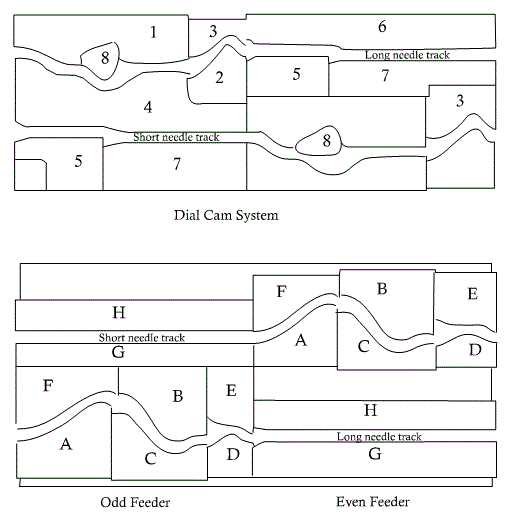
    Interlock cam system:
    In the figure the cylinder and dial camming to produce one course of ordinary interlock fabric which is actually work of two knitting feeders.

    The cylinder cam:

    A → clearing cam which lifts the needles to clear the old loop
    B, C → stitch cam and guard cams respectively both vertically adjustable to control the stitch length.
    D → up through to rise the needle whilst dial needle knock over
    E, F → guard cam to complete the truck
    G, H → guide cam to provide the track for idling needles
     

    Cylinder Cam System
    The dial system:
    1. Raising cam for tuck position only
    2, 3. Dial knock over cam
    4. Guard cam to compete the truck
    5. Auxiliary knock over cam to prevent the dial needle reentering the old loop
    6, 7 Guide cams provides the tracks for idling needles
    8. Sewing type clearing cam which may occupy the knitting position as shown in feeder 1 or in tuck position at feeder 2.

    Machine parts:

    1.  Yarn career 
    2.  Break stop motion 
    3.  Yarn guides 
    4.  Dial 
    5.  Cylinder 
    6.  Dial cams 
    7.  Cylinder cams 
    8.  Dial needles 
    9.  Cylinder needles 
    10.  Oiling and air following devices 
    11.  Sensors 
    12.  Take up rollers 
    13.  Batch rollers 
    14.  Motor 
    15.  Belts 
    16.  Pulleys and gears  Clutches
    Knitting action: 

    Conclusion:
    The circular Interlock machine is a very commonly used machine in country to make Interlock knitted fabric. So this experiment has significance in our study life. In this experiment we sketch the yarn path diagram of the machine, show the knitting action, cam system. We point out the various specification of the machine. So the experiment helps us to know more.

    Above all the experiment is a successful one.

    Interlock Circular Knitting Machine | Knitting Action of InterlockCircular Knitting Machine

    Posted at  04:28  |  in  regular  |  Continue lendo ...»

    Name of the Experiment: Study on interlock circular knitting machine.

    OBJECTS:
    1.To have the idea about an interlock m/c .
    2.To know about its working principles.

    Introduction:
    Interlock structure is a double faced Interlock structure which consists of two 1×1 Interlock structures. These two 1×1 Interlock structures are joined by interlocking sinker loops and thus produce interlock structure. Interlock structure is produce by special cylinder dial circular machines. Double system V-bed flat knitting machine also used to produce interlock structure.

    SPECIFICATIONS:

    1. Machine name: Interlock Circular Knitting Machine.
    2. Company:- Precision FUKUHARA Works Limited.
    3. Origin of the machine:- Japan
    4. Model no. :- V 8ME 42 
    5. Dia of the machine:- 30”.
    6. Gauge of the machine:- 22 
    7. No of Feeder:- 84 
    8. Serial no:- 1352761.
    9. Creel Capacity: 84.
    10. Feeding: Positive.
    MACHINE PARTS:
    1.Yarn career
    2.Break stop motion
    3.Yarn guides
    4.Dial
    5.Cylinder
    6.Dial cams
    7.Cylinder cams
    8.Dial needles
    9.Cylinder needles
    10.Oiling and air following devices
    11.Sensors
    12.Take up rollers
    13.Batch rollers
    14.Motor
    15.Belts 16.Clutches
    17.Pulleys and gears

    Machine description:
    The machine has two sets of needles on two different beds, one set on cylinder one in the dial bed. These two sets of needles must be exactly opposite to each other.

    The machine has two separate cam system in each bed needles of different length called short needles and long needles. Each cam system controls half of the needles in alternate sequences. One cam system controls knitting at one feeder and other ca, system controls at the next feeders. T ale down mechanism is the same as the other Interlock and plain machines mechanism.

    Interlock cam system:
    In the figure the cylinder and dial camming to produce one course of ordinary interlock fabric which is actually work of two knitting feeders.

    The cylinder cam:

    A → clearing cam which lifts the needles to clear the old loop
    B, C → stitch cam and guard cams respectively both vertically adjustable to control the stitch length.
    D → up through to rise the needle whilst dial needle knock over
    E, F → guard cam to complete the truck
    G, H → guide cam to provide the track for idling needles
     

    Cylinder Cam System
    The dial system:
    1. Raising cam for tuck position only
    2, 3. Dial knock over cam
    4. Guard cam to compete the truck
    5. Auxiliary knock over cam to prevent the dial needle reentering the old loop
    6, 7 Guide cams provides the tracks for idling needles
    8. Sewing type clearing cam which may occupy the knitting position as shown in feeder 1 or in tuck position at feeder 2.

    Machine parts:

    1.  Yarn career 
    2.  Break stop motion 
    3.  Yarn guides 
    4.  Dial 
    5.  Cylinder 
    6.  Dial cams 
    7.  Cylinder cams 
    8.  Dial needles 
    9.  Cylinder needles 
    10.  Oiling and air following devices 
    11.  Sensors 
    12.  Take up rollers 
    13.  Batch rollers 
    14.  Motor 
    15.  Belts 
    16.  Pulleys and gears  Clutches
    Knitting action: 

    Conclusion:
    The circular Interlock machine is a very commonly used machine in country to make Interlock knitted fabric. So this experiment has significance in our study life. In this experiment we sketch the yarn path diagram of the machine, show the knitting action, cam system. We point out the various specification of the machine. So the experiment helps us to know more.

    Above all the experiment is a successful one.

    Name of the experiment: Study on Rib Circular knitting machine. 

    Introduction
    The structure in which the face and back loop occurs along to the coarse successively but all the loops of a wale is same is called rib structure. The circular knitting machine which is used to produce the rib structures is known as rib machine.

    Machine specification:

    1. Machine model → cmoan
    2. Manufacturer → Paolo Orizio
    3. Made in → Italy
    4. No of feeders’ → 40 
    5. Cylinder diameter →20”
    6. Needle gauge → 18 / inch
    Machine parts:
    1.  Yarn career
    2.  Break stop motion
    3.  Yarn guides
    4.  Dial
    5.  Cylinder
    6.  Dial cams
    7.  Cylinder cams
    8.  Dial needles
    9.  Cylinder needles
    10.  Oiling and air following devices
    11.  Sensors
    12.  Take up rollers
    13.  Batch rollers
    14.  Motor
    15.  Belts
    16.  Pulleys and gears
    17.  Clutches
    Description of the machine:
    In a dial cylinder rib machine there is one set of needles on the circumference of the vertical cylinder and another set of needles on a horizontal dial. So two sets of needles remain at the right angle with each other. In dial cylinder machines the dial and cylinder rotates but the cam systems with the feeders remain stationary.

    The dial needles get its motion from its butt which is placed on the cam truck. This cam truck is formed by different cam placed on a cam plate.

    During the rotation of the cylinder, cylinder needles moves vertically and dial needles moves horizontally. Cylinder needles also get its motion from it. There is a cloth tale up roller which also rotates with unison to dial and cylinder and fabric is wound on it. 

    In rib circular knitting m/c, Rib gaiting:

     Knitting action:
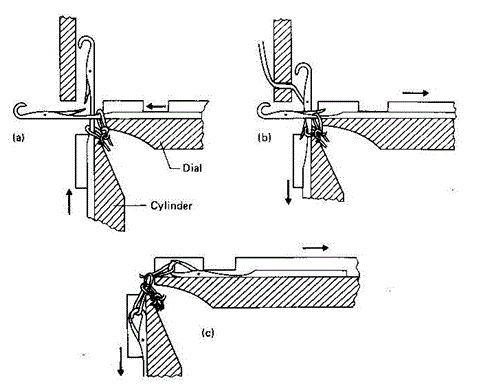
    The knitting action of a circular rib machine is shown in Fig:

    1. Clearing: The cylinder and dial needles move out to clear the plain and rib loops formed in the previous cycle.

    2. Yarn feeding: The needles are withdrawn into their tricks so that the old loops are covered by the open latches and the new yarn is fed into the open hooks.

    3. Knocking Over: The needles are withdrawn into their tricks so that the old loops are cast off and new loops are drawn through them.
     

    Fig: Knitting action of rib circular knitting machine
    Conclusion:
    This experiment has significance in our study life. In this experiment we sketch the yarn path diagram of the machine, show the knitting action, cam system. We point out the various specification of the machine.

    Rib Circular Knitting Machine

    Posted at  03:32  |  in  regular  |  Continue lendo ...»

    Name of the experiment: Study on Rib Circular knitting machine. 

    Introduction
    The structure in which the face and back loop occurs along to the coarse successively but all the loops of a wale is same is called rib structure. The circular knitting machine which is used to produce the rib structures is known as rib machine.

    Machine specification:

    1. Machine model → cmoan
    2. Manufacturer → Paolo Orizio
    3. Made in → Italy
    4. No of feeders’ → 40 
    5. Cylinder diameter →20”
    6. Needle gauge → 18 / inch
    Machine parts:
    1.  Yarn career
    2.  Break stop motion
    3.  Yarn guides
    4.  Dial
    5.  Cylinder
    6.  Dial cams
    7.  Cylinder cams
    8.  Dial needles
    9.  Cylinder needles
    10.  Oiling and air following devices
    11.  Sensors
    12.  Take up rollers
    13.  Batch rollers
    14.  Motor
    15.  Belts
    16.  Pulleys and gears
    17.  Clutches
    Description of the machine:
    In a dial cylinder rib machine there is one set of needles on the circumference of the vertical cylinder and another set of needles on a horizontal dial. So two sets of needles remain at the right angle with each other. In dial cylinder machines the dial and cylinder rotates but the cam systems with the feeders remain stationary.

    The dial needles get its motion from its butt which is placed on the cam truck. This cam truck is formed by different cam placed on a cam plate.

    During the rotation of the cylinder, cylinder needles moves vertically and dial needles moves horizontally. Cylinder needles also get its motion from it. There is a cloth tale up roller which also rotates with unison to dial and cylinder and fabric is wound on it. 

    In rib circular knitting m/c, Rib gaiting:

     Knitting action:
    The knitting action of a circular rib machine is shown in Fig:

    1. Clearing: The cylinder and dial needles move out to clear the plain and rib loops formed in the previous cycle.

    2. Yarn feeding: The needles are withdrawn into their tricks so that the old loops are covered by the open latches and the new yarn is fed into the open hooks.

    3. Knocking Over: The needles are withdrawn into their tricks so that the old loops are cast off and new loops are drawn through them.
     

    Fig: Knitting action of rib circular knitting machine
    Conclusion:
    This experiment has significance in our study life. In this experiment we sketch the yarn path diagram of the machine, show the knitting action, cam system. We point out the various specification of the machine.

    Sunday, 29 January 2012

    Experiment name: Study on four truck single jersey circular knitting m\c.

    Objects:
    —To identify the four truck single jersey circular knitting m\c.
    —To know about it’s different parts.
    —To know the function of it’s different parts.
    —To know the operation of this m\c.

    Identification:
    1. Cylinder is open, no dial.
    2. Cylinder & sinker plate are present.
    3. Close cam box.
    4. Cylinder can not be seen.
    5. Needle can not be seen.
    6. Positive cam system.
    7. Positive feed system. 

    Specification of the machine:

    1. Machine no:-1. 4-Truck Single Jersey Circular Knitting Machine.
    2. Company:- PAOLO ORIZIO.
    3. Origin of the machine:- ITALY.
    4. Model no. :- GOH N/C.
    5. Dia of the machine:- 22”.
    6. Gauge of the machine:- 24 
    7. No of Feeder:- 66 
    8. No of Needle: Π*24*22.
    9. Creel Capacity: 144.
    10. Sinker type: 2061905G.
    Main parts:
    1. 4(butt) latch needle,
    2. Holding down sinker,
    3. Cam &cam box,
    4. Sinker plate& sinker cam plate,
    5. Cylinder,
    6. Feeder(+ve)
    7. Needle detector,
    8. Fabric detector,
    9. V.D.Q. pulley,
    10. Spreader,
    11. Take down roller,
    12. Cloth roller.
    Description: 
    The single jersey circular knitting m/c is one of the modern m/c. It has one set of needle and another set of sinkers. Both needle and sinkers have different cam system. Cam system are stationary and the cylinder with needle and sinkers are movable. The yarn feeder is stationary. The yarn is coming from cheese or cone package by yarn guide, north catcher, accumulator and yarn guide or feeder. The fabric draw off by the side of the needle and it take up by take up roller. There is alighting system to inspection the fabric. The m/c has positive feed system and breakage indicator.

    Operating Principle: 
    As the m\c is modern, it has a control panel of it’s own. In a switch box three switches are available. One is for full sewing, one is for m\c stop & another is for machine motion. By the inching motion switch, the m\c can be run slowly or fastly. Beside this switch box another control panel is available. It has different functions, switches as F1.F2……f6 have their particular functions.

    Conclusion: 
    In circular knitting m/c there many set of cams but in V-bed knitting m/c there only one set of cam for each bed. From this practical we learn about the cams of V-bed knitting m/c and their function. We also learn how can we change design of loops as well as fabric by changing can arrangement. I think this practical will help me in future.

    Four Truck Single Jersey Circular Knitting Machines

    Posted at  02:36  |  in  regular  |  Continue lendo ...»

    Experiment name: Study on four truck single jersey circular knitting m\c.

    Objects:
    —To identify the four truck single jersey circular knitting m\c.
    —To know about it’s different parts.
    —To know the function of it’s different parts.
    —To know the operation of this m\c.

    Identification:
    1. Cylinder is open, no dial.
    2. Cylinder & sinker plate are present.
    3. Close cam box.
    4. Cylinder can not be seen.
    5. Needle can not be seen.
    6. Positive cam system.
    7. Positive feed system. 

    Specification of the machine:

    1. Machine no:-1. 4-Truck Single Jersey Circular Knitting Machine.
    2. Company:- PAOLO ORIZIO.
    3. Origin of the machine:- ITALY.
    4. Model no. :- GOH N/C.
    5. Dia of the machine:- 22”.
    6. Gauge of the machine:- 24 
    7. No of Feeder:- 66 
    8. No of Needle: Π*24*22.
    9. Creel Capacity: 144.
    10. Sinker type: 2061905G.
    Main parts:
    1. 4(butt) latch needle,
    2. Holding down sinker,
    3. Cam &cam box,
    4. Sinker plate& sinker cam plate,
    5. Cylinder,
    6. Feeder(+ve)
    7. Needle detector,
    8. Fabric detector,
    9. V.D.Q. pulley,
    10. Spreader,
    11. Take down roller,
    12. Cloth roller.
    Description: 
    The single jersey circular knitting m/c is one of the modern m/c. It has one set of needle and another set of sinkers. Both needle and sinkers have different cam system. Cam system are stationary and the cylinder with needle and sinkers are movable. The yarn feeder is stationary. The yarn is coming from cheese or cone package by yarn guide, north catcher, accumulator and yarn guide or feeder. The fabric draw off by the side of the needle and it take up by take up roller. There is alighting system to inspection the fabric. The m/c has positive feed system and breakage indicator.

    Operating Principle: 
    As the m\c is modern, it has a control panel of it’s own. In a switch box three switches are available. One is for full sewing, one is for m\c stop & another is for machine motion. By the inching motion switch, the m\c can be run slowly or fastly. Beside this switch box another control panel is available. It has different functions, switches as F1.F2……f6 have their particular functions.

    Conclusion: 
    In circular knitting m/c there many set of cams but in V-bed knitting m/c there only one set of cam for each bed. From this practical we learn about the cams of V-bed knitting m/c and their function. We also learn how can we change design of loops as well as fabric by changing can arrangement. I think this practical will help me in future.

    Experiment name: Study on Electronic Interlock Circular Knitting Machine

    Introduction:
    Interlock structure is a double faced Interlock structure which consists of two 1×1 Interlock structures. These two 1×1 Interlock structures are joined by interlocking sinker loops and thus produce interlock structure. Interlock structure is produce by special cylinder dial circular machines. Double system V-bed flat knitting machine also used to produce interlock structure.

    Machine specification:

    Brand: FUKUHARA
    Model: V8ME42
    Origin: Japan
    Manufacturing Company: Precision Fukuhara Works. Ltd.
    Serial: 1352761
    Dia of cylinder: 30 inch

    Machine description:

    The machine has two sets of needles on two different beds, one set on cylinder one in the dial bed. These two sets of needles must be exactly opposite to each other.

    The machine has two separate cam system in each bed needles of different length called short needles and long needles. Each cam system controls half of the needles in alternate sequences. One cam system controls knitting at one feeder and other ca, system controls at the next feeders. T ale down mechanism is the same as the other Interlock and plain machines mechanism.

    Machine parts:

    1. Yarn career 
    2. Break stop motion 
    3. Yarn guides 
    4. Dial 
    5. Cylinder 
    6. Dial cams 
    7. Cylinder cams 
    8. Dial needles 
    9. Cylinder needles 
    10. Oiling and air following devices 
    11. Sensors 
    12. Take up rollers 
    13. Batch rollers 
    14. Motor 
    15. Belts 
    16. Pulleys and gears  
    17. Clutches
    Interlock cam system:
    In the figure the cylinder and dial cam to produce one course of ordinary interlock fabric which is actually work of two knitting feeders.

    The cylinder cam:

    A → clearing cam which lifts the needles to clear the old loop
    B, C → stitch cam and guard cams respectively both vertically adjustable to control the stitch length.
    D → up through to rise the needle whilst dial needle knock over
    E, F → guard cam to complete the truck
    G, H → guide cam to provide the track for idling needles

    The dial cam system:

    Raising cam for tuck position only

    2, 3. Dial knock over cam
    4. Guard cam to compete the truck
    Auxiliary knock over cam to prevent the dial needle reentering the old loop
    6, 7 Guide cams provides the tracks for idling needles
    8. Sewing type clearing cam which may occupy the knitting position as shown in feeder 1 or in tuck position at feeder 2.

    Knitting action:
    The knitting cycle of a interlock machine can be divided in to eight headings. They are discussed below,

    Position – 1: rest position
    Position – 2: tucking position of dial needle
    Position – 3: tucking position
    Position – 4: clearing position of dial needle
    Position – 5: clearing position
    Position – 6: yarn presenting position
    Position – 7: cast on position
    Position – 8: knock over position 

    Fig: Knitting action of interlock m/c

    Conclusion:
    The circular Interlock machine is a very commonly used machine in country to make Interlock knitted fabric. So this experiment has significance in our study life. In this experiment we sketch the yarn path diagram of the machine, show the knitting action, cam system. We point out the various specification of the machine. So the experiment helps us to know more. Above all the experiment is a successful one. 

    Electronic Interlock Circular Knitting Machine | Knitting Action ofInterlock m/c

    Posted at  01:17  |  in  regular  |  Continue lendo ...»

    Experiment name: Study on Electronic Interlock Circular Knitting Machine

    Introduction:
    Interlock structure is a double faced Interlock structure which consists of two 1×1 Interlock structures. These two 1×1 Interlock structures are joined by interlocking sinker loops and thus produce interlock structure. Interlock structure is produce by special cylinder dial circular machines. Double system V-bed flat knitting machine also used to produce interlock structure.

    Machine specification:

    Brand: FUKUHARA
    Model: V8ME42
    Origin: Japan
    Manufacturing Company: Precision Fukuhara Works. Ltd.
    Serial: 1352761
    Dia of cylinder: 30 inch

    Machine description:

    The machine has two sets of needles on two different beds, one set on cylinder one in the dial bed. These two sets of needles must be exactly opposite to each other.

    The machine has two separate cam system in each bed needles of different length called short needles and long needles. Each cam system controls half of the needles in alternate sequences. One cam system controls knitting at one feeder and other ca, system controls at the next feeders. T ale down mechanism is the same as the other Interlock and plain machines mechanism.

    Machine parts:

    1. Yarn career 
    2. Break stop motion 
    3. Yarn guides 
    4. Dial 
    5. Cylinder 
    6. Dial cams 
    7. Cylinder cams 
    8. Dial needles 
    9. Cylinder needles 
    10. Oiling and air following devices 
    11. Sensors 
    12. Take up rollers 
    13. Batch rollers 
    14. Motor 
    15. Belts 
    16. Pulleys and gears  
    17. Clutches
    Interlock cam system:
    In the figure the cylinder and dial cam to produce one course of ordinary interlock fabric which is actually work of two knitting feeders.

    The cylinder cam:

    A → clearing cam which lifts the needles to clear the old loop
    B, C → stitch cam and guard cams respectively both vertically adjustable to control the stitch length.
    D → up through to rise the needle whilst dial needle knock over
    E, F → guard cam to complete the truck
    G, H → guide cam to provide the track for idling needles

    The dial cam system:

    Raising cam for tuck position only

    2, 3. Dial knock over cam
    4. Guard cam to compete the truck
    Auxiliary knock over cam to prevent the dial needle reentering the old loop
    6, 7 Guide cams provides the tracks for idling needles
    8. Sewing type clearing cam which may occupy the knitting position as shown in feeder 1 or in tuck position at feeder 2.

    Knitting action:
    The knitting cycle of a interlock machine can be divided in to eight headings. They are discussed below,

    Position – 1: rest position
    Position – 2: tucking position of dial needle
    Position – 3: tucking position
    Position – 4: clearing position of dial needle
    Position – 5: clearing position
    Position – 6: yarn presenting position
    Position – 7: cast on position
    Position – 8: knock over position 

    Fig: Knitting action of interlock m/c

    Conclusion:
    The circular Interlock machine is a very commonly used machine in country to make Interlock knitted fabric. So this experiment has significance in our study life. In this experiment we sketch the yarn path diagram of the machine, show the knitting action, cam system. We point out the various specification of the machine. So the experiment helps us to know more. Above all the experiment is a successful one. 

    Friday, 27 January 2012

    Experiment name: Compare between single jersey 4-truck and rib circular knitting machine.

    Objects:

    —To know difference between single jersey 4-truck & rib circular knitting m\c.
    —To know similarities between these m\cs.
    —To identify the single jersey 4-truck & rib circular knitting m\c.

    Machine specification:

    Single jersey 4-truck circular knitting machine.

    1. Company:- PAOLO ORIZIO
    2. Origin of the machine:- ITALY.
    3. Model no. :- GOH N/C
    4. Dia of the machine:- 22”.
    5. Gauge of the machine:- 26 
    6. No of Feeder:- 66 
    Rib circular knitting machine.
    1. Company:- ORIZIO POALO SPA
    2. Origin of the machine:- ITALY.
    3. Model no. :- CMOAN
    4. Serial no:- 1026338 
    5. Dia of the machine:- 20”
    6. Gauge of the machine:- 18 
    7. No of Feeder :- 40
    8. No of Needle:- 1128


    Single jersey 4-truck  knitting M/C

    Rib circular knitting M/C
    1. Top side is open.
    1. Top side is closed.
    1. Cylinder needle is used in cylinder.
    1. Cylinder & dial are used in this m/c
    1. Sinker and sinker ring is used in the top of cylinder.
    1. Two set needle used one for cylinder and one for dial.
    1. 4-butt neddle and 4-cam truck are used in this machine.
    1. 2-butt cylinder needle optional present here. 2-butt dial neddle used in this machine. 2-cam truck optional but single cam truck used in the cylinder and 2-cam truck used in the dial.
    1. Positive feeder
    1. Positive feeder

    1. Synchronized timing.
    1. Synchronized timing.

    1. Side creel used
    1. Side creel used
    1. Holding down sinker.
    1. Sinker not used in this machine.
    1. Neddle detector and fabric detector are present
    1. Neddle detector and fabric detector are present.
    1. Cylinder and sinker ring are present.
    1. Cylinder and dial are present.

    1. Cam arrangement like:
    1. Cam arrangement like:
    1. Chain notation like:
    1. Chain notation like:

     
    Conclusion: 
    It is a very important experiment for us. It is very helpful in our student life as well as our job life.

    Single Jersey 4-Truck Circular Knitting Machine | Rib Circular KnittingMachine

    Posted at  04:26  |  in  regular  |  Continue lendo ...»

    Experiment name: Compare between single jersey 4-truck and rib circular knitting machine.

    Objects:

    —To know difference between single jersey 4-truck & rib circular knitting m\c.
    —To know similarities between these m\cs.
    —To identify the single jersey 4-truck & rib circular knitting m\c.

    Machine specification:

    Single jersey 4-truck circular knitting machine.

    1. Company:- PAOLO ORIZIO
    2. Origin of the machine:- ITALY.
    3. Model no. :- GOH N/C
    4. Dia of the machine:- 22”.
    5. Gauge of the machine:- 26 
    6. No of Feeder:- 66 
    Rib circular knitting machine.
    1. Company:- ORIZIO POALO SPA
    2. Origin of the machine:- ITALY.
    3. Model no. :- CMOAN
    4. Serial no:- 1026338 
    5. Dia of the machine:- 20”
    6. Gauge of the machine:- 18 
    7. No of Feeder :- 40
    8. No of Needle:- 1128


    Single jersey 4-truck  knitting M/C

    Rib circular knitting M/C
    1. Top side is open.
    1. Top side is closed.
    1. Cylinder needle is used in cylinder.
    1. Cylinder & dial are used in this m/c
    1. Sinker and sinker ring is used in the top of cylinder.
    1. Two set needle used one for cylinder and one for dial.
    1. 4-butt neddle and 4-cam truck are used in this machine.
    1. 2-butt cylinder needle optional present here. 2-butt dial neddle used in this machine. 2-cam truck optional but single cam truck used in the cylinder and 2-cam truck used in the dial.
    1. Positive feeder
    1. Positive feeder

    1. Synchronized timing.
    1. Synchronized timing.

    1. Side creel used
    1. Side creel used
    1. Holding down sinker.
    1. Sinker not used in this machine.
    1. Neddle detector and fabric detector are present
    1. Neddle detector and fabric detector are present.
    1. Cylinder and sinker ring are present.
    1. Cylinder and dial are present.

    1. Cam arrangement like:
    1. Cam arrangement like:
    1. Chain notation like:
    1. Chain notation like:

     
    Conclusion: 
    It is a very important experiment for us. It is very helpful in our student life as well as our job life.

    Super Ofertas

    --
    Copyright © 2013 fibres2fashion. Blogger Template by BloggerTheme9
    Proudly Powered by Blogger.
    back to top